Mormon Bishops
Bishops of The Church of Jesus Christ of Latter-day Saints (also referred to as the Mormon Church) are the ward (local congregation) leaders. The leaders of the Mormon Church, including bishops, are a lay ministry. This means that they volunteer their services and are not paid for them. A bishop has many responsibilities. He is often referred to as the “father of the ward” because he is supposed to make sure that all the families and individuals in his ward have both their temporal and spiritual needs met. Because of this, he is considered the spiritual leader of the congregation. Two other men are called to assist the bishop in his duties. These men are known as the first and second counselors in the bishopric. Because the duties and responsibilities of a bishop are so numerous and varied, this article will be broken down into different sections.
President of the Aaronic Priesthood
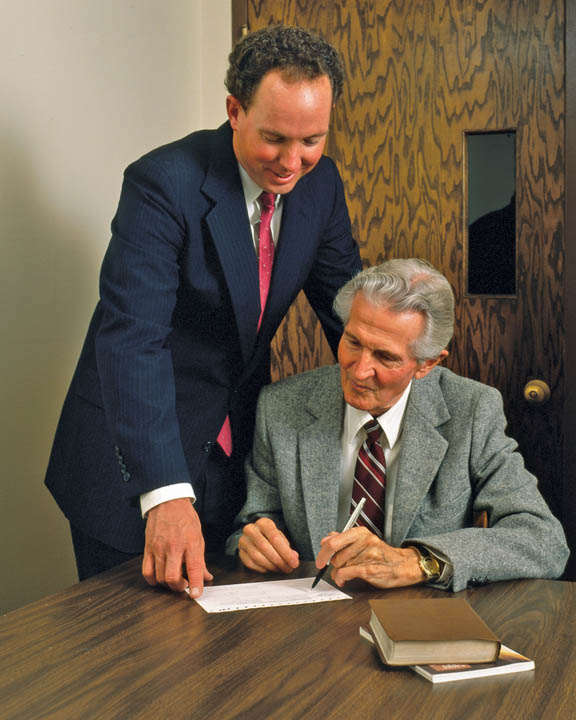 In this role, the bishop is responsible for the young men and women of his ward. In a news release sent out by the Church entitled “Latter-day Saint Bishops: Lay Ministers Who Know Something About Service” it states,
One of his important priorities is helping parents meet the spiritual needs of their young people — ages 12 through 18. He regularly meets with these teenagers, one on one, helping them resolve personal difficulties and set goals that encourage them to live in harmony with the teachings of the Church. Because his role with youth supplements the efforts of their parents, he encourages youth to be open with and seek advice from parents in all aspects of their lives. He helps young people and adults prepare and live worthily to enter Latter-day Saint temples. He also approves and helps plan all youth activities in the ward, teaching leadership skills to youth and training them to serve and reach out to others (lds.org).
Presiding High Priest
In this capacity the bishop is given the keys to spiritually lead his ward. His authority remains within the bounds of his ward. He has no presiding authority over any other part of the Mormon Church. In this position, the bishop presides over ward council meetings and priesthood executive council meetings (these two groups include members in various callings and help the bishop know the needs of the members and make decisions for the ward).
Judge in Israel
In Doctrine and Covenants 107:73-74, it says,
This is the duty of a bishop who . . . has been ordained to the High Priesthood after the order of Melchizedek. Thus shall he be a judge, even a common judge among the inhabitants of Zion, or in a stake of Zion, or in any branch of the church where he shall be set apart unto this ministry, until the borders of Zion are enlarged and it becomes necessary to have other bishops or judges in Zion or elsewhere.
In this capacity, the bishop conducts interviews to determine worthiness for such things as temple recommends (which show a person’s worthiness to enter Mormon temples), priesthood ordination (for the men), and Mormon missionary calls. He is also the person to whom people who have committed serious sins confess. He then determines how to best deal with these sins and help the person repent. In this role, a bishop is also a counselor and is able to give spiritual as well as temporal advice.
Temporal Matters
Doctrine and Covenants 107:68 reads, “For the office of a bishop is in administering all temporal things.” In this area, the bishop is responsible for the ward’s finances and records. He receives members’ tithes and offerings, and coordinates the ward’s budget.
Welfare Services
“And the bishop . . . should travel round about . . . searching after the poor to administer to their wants by humbling the rich and the proud” (Doctrine and Covenants 84:112). Elder J. Reuben Clark said the following about a bishop’s role in welfare service:
To the bishop is given all the powers and responsibilities which the Lord has specifically prescribed in the Doctrine and Covenants for the caring of the poor. . . . No one else is charged with this duty and responsibility, no one else is endowed with the power and functions necessary for this work. . . .
By the word of the Lord the sole mandate to care for, and the sole discretion in caring for the poor of the Church is lodged in the bishop. . . . It is his duty and his only to determine to whom, when, how, and how much shall be given to any member of his ward from Church funds and as ward help.
This is his high and solemn obligation, imposed by the Lord Himself. The bishop cannot escape this duty; he cannot shirk it; he cannot pass it on to someone else, and so relieve himself. Whatever help he calls in, he is still responsible (as quoted by Marion G. Romney, “The Role of Bishops in Welfare Services,” Ensign, Nov. 1977, p. 79).
From this passage, it is obvious that welfare is an important role of a bishop. When families are in financial trouble, the bishop is responsible for making sure that their basic needs are met. He can do this by helping them create a budget and debt reduction plan, by providing temporary assistance, or by simply giving them advice.
Other Roles a Bishop Fulfills
A bishop presides over and conducts meetings. He is often asked to preside over funerals. Where it is legal, the bishop may also conduct civil marriages.