Mormon Endowments
 In dictionary terms, an endowment is a gift. However, for the Mormon religion (properly called the Church of Jesus Christ of Latter-day Saints), an endowment is a special ordinance (or sacred ritual) performed in Mormon temples. In an endowment, members are taught, perform sacred rituals, and make covenants, or promises, with the Lord. To participate in an endowment, one must be a worthy, prepared, and adult member of the Church.“Endow” has a different meaning in the New Testament, as well. It means “to clothe” or “to instill qualities in.” Christ, after his resurrection, told His apostles to stay in Jerusalem until “endued with power from on high” (Luke 24:49). The day of Pentecost in Acts 2 is presented as the fulfillment. The Apostles received power from on high on that day – when the Holy Ghost manifested Himself in great glory and gave strength and the power of revelation to the disciples.
And what do Mormons believe? They believe their Church to be a restoration of the original one established by Jesus Christ. Part of the restoration is the priesthood— the authority to act in God’s name —and the practice of worshipping the Lord in holy temples. Joseph Smith, founder of the Mormon Church, introduced the ordinances that ought to be performed in the Mormon temple in 1842. He taught that the ordinances were “of things spiritual, and to be received only by the spiritual minded.” And the endowment revealed the entirety of the human condition and man’s connection with God. It was essential preparation for Mormon missionaries. The blessings it offers are complete, and it gives more power to the faithful to fight temptation.
There are four aspects to a Mormon endowment. The first one is one of preparation –the participant is ceremonially washed and anointed, then dressed in temple garments (also, popularly, called Mormon underwear) and temple robes. Both garments and robes are white, symbolizing purity and the equality of all the participants. The next aspect is a course of instruction. This teaches about the creation of the world, about more experiences of Adam and Eve, and the plan of salvation God has set forth for our sake, which is possible thanks to the atonement of Christ. Next come covenants. In these, Mormons promise the Lord their obedience, unselfishness, chastity, and loyalty to His Church. And, in return, God promises joy, protection, progress and an eventual return to Him. At the last, Mormons feel His divine presence, for the temple is the House of the Lord, a house of light, peace, revelation, and understanding. In the temple, the Lord’s hand is felt.
The endowment is very symbolic and very deep and members are encouraged to participate in this ordinance multiple times, growing closer to the Lord with each repetition.
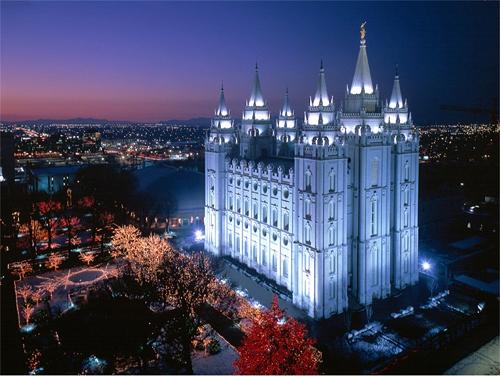 The symbols used in endowment, and their meanings, are sacred to Mormons. To them, the meaning of these symbols is knowledge given of God, and the only place where it is right to discuss the symbols is inside the temple. Faithful Mormons will keep the specific details of the endowment private, because of their sacredness.
In Mormon belief, the endowment is for a member’s benefit. The first time a Mormon man goes through an endowment session is, usually, before he goes on his mission at 19. Mormon women usually receive their endowment before marriage, or, if they plan to go on a mission, at 21, just before they leave.
Every time Mormons repeat the endowment session, they receive the endowment, not just for themselves, but on behalf of the dead. This allows departed spirits to accept or reject the ordinance, on their own free will. Mormons believe in receiving ordinances on behalf of the dead, believing that, after death, we don’t stop the process of being saved or receiving more knowledge.